Epistemology:
Traditional Account
of Knowledge
John Locke and the
Causal Theory of Perception
Primary and Secondary Properties
Locke’s View in Sum and Implications
Consequences for Philosophy (et al.)
Opens the door to Radical Relativism
What
do you know? I
· I know I have a hand.[1]
· I know that Paris is
the capital of France.[2]
· I know that gold’s
atomic number is 79.[3]
· I know that a rook
can move horizontally or vertically on the chess board. [4]
· I know what a rose smells like.[5]
· I know how to ride a
bike.[6]
· I know where is live.[7]
· I know who I am.
(most days).[8]
But
all these really refer to importantly different “ways of knowing” or “kinds” of
knowledge. In Western philosophy, we
have concentrated mostly of “propositional” knowledge. By the way, a “propositional belief” is a
“that” belief: I believe that… The “proposition” is what comes after the
“that.” (e.g.
that the Earth revolves around the sun, that Tuesday comes after Monday;
that square root of four is two).
So
much emphasis on propositional knowledge has lead to the impression that all knowledge is
propositional and that anything worth knowing can be expressed in
propositions. (Those “that” phrases I
was talking about.) I think this is
problem[9], and
this is one of the things we’ll talking about throughout the semester.
Traditional Account
of Knowledge
Plato
argues that knowledge is best understood as “true, justified belief.” That is, to say that Jose knows
that Mary is guilty of cheating on her quiz is to say:
- Jose believes that Mary is guilty.
- It is true that Mary is guilty.
- Jose has a good reason (justification) for his belief that
Mary is guilty.
Kn= TJB.
This
is referred to that the “Traditional Account of Knowledge.” As I say, this has been widely accepted as THE
correct understanding of knowledge for the better part of Western history. More recently it has been challenged and we
will be looking both at the traditional account of knowledge and its challenges
throughout the semester. Today, however,
I want to concentrate on how the traditional understanding of knowledge along
with empiricist models of mind have come to influence contemporary popular conceptions
of what can and what cannot count as knowledge.
In the second half of my lecture today I will be looking at Active Theories of perception and some
of its consequences for knowledge, truth and
justification.
Plato’s
Allegory of the Cave:
Key
to understanding Platonic thought is the distinction between appearance and
reality. Not everything that appears to
be true is true, not everything that appears to be good is good and for Plato,
it even followed that not everything that appears to be beautiful is beautiful. If this is so, then the role of philosophy is
to help us the distinguish between the truth and mere appearance of truth,
goodness and the mere appearance of goodness, and beauty and the mere
appearance of beauty. Epistemology is
the branch of philosophy which addresses the first of these, while Ethics and
Aesthetics deal with the second and third of these.
So
how do we acquire knowledge? How do we
avoid deception and error? Plato
suggested that the senses are deceptive, and that the most reliable knowledge
came from reason and introspection. He
can point to the reliability of math and geometry to prove his point. Note that mathematical truths can be known
with absolute certainty. We do not need to update calculus textbooks nearly
as often as we need to update physics and biology texts. This confidence in reason and distrust of the
sensory is characteristic of one of the two great traditions in Western
epistemology: Rationalism.
But
Plato’s best student and best critic was the philosopher Aristotle. In contrast to Plato, Aristotle held that the
best way to come to know objective truth, indeed the ONLY way to come to know
objective truth, is via sensory experience.
This is the second of the two great traditions: Empiricism.
These
two viewpoints battled against one another for the next 2000 years. Historically the was St. Augustine, who was a
rationalist, and, in contrast, St. Thomas Aquinas, an empiricist.
Early Modern Philosophers[10]
|
Continental
Rationalists: |
British
Empiricists:
|
|
•
René Descartes French-
1596-1650 •
Baruch Spinoza Portuguese/Dutch
1632-1677 •
Gottfried Leibniz German-
1646-1716 |
•
John Locke English
1632-1704 •
George Berkeley Irish
1685-1753 •
David Hume Scottish
1711-1776 |
Over
time Empiricism came to dominate philosophy in the United Kingdom, and
eventually the United States. It is this
tradition, I contend, that has had the greatest influence on contemporary popular
thinking about knowledge, truth and justification in the United States. There are several features of this view that
I would like to highlight and ask you to examine. The first of these is the nature of
perception.
John
Locke and the Causal Theory of Perception
John
Lock (1632 -1704) was one of the three “British Empiricists” of the
Enlightenment period.[11] As am Empiricist, Locke was committed to the
idea that there were no such things as “innate ideas” and that the best, indeed
the only way, to come to know objective truth was via sensory experience.
·
The only way to come to know the world is through sensory
experience.
·
Agrees with St. Thomas Aquinas- that, “Nothing is in the
mind without first having been in the senses.”[12]
·
Locke claims that we start life with a blank slate,
"tabula rasa[13]."
Further,
Locke rejects the “direct realism” or “naïve realism” of pre-Modern philosophy.
Rather than contend that we directly grasp reality in perception, Locke, like
Descartes, claims we grasp only our mental representations of reality. We get the “video feed,” but do not see the
world outside directly. The question
then becomes” How can we go from knowledge of our perceptions (the video feed)
to knowledge of extra-mental reality (the world outside)?
·
Points out that there is the
(1) world
and
(2) there
are ideas
about the world.
·
This places critical importance on determining: What
is the connection between reality and our minds?
The Problem of Perception and the
External World
Whoever
wishes to become a philosopher must learn not to be frightened by absurdities.
------Bertrand Russell, Problems
of Philosophy
These
skeptical worries enter Western Philosophy with a vengeance with Descartes et
alia.
·
Are things as they seem?
·
Are there objects independent of me?
·
Are there other minds?
·
And even if there are…
·
…how could I ever know any of these things?
Direct (“Naïve”) Realism: Physical
objects are directly (“immediately”) perceived.
We don’t need to justify an inference from sensory experience to
physical reality because physical objects are the objects of sensory
experience.
Representational Ralism (indirect
realism): The immediate objects of experience represent the physical objects
which cause them.
Sense Data Theories:
The objects of immediate experience are sense data—private, non-physical
entities, “ideas.”
Phenomenalism: Physical
objects are reducible to the occurrence of the immediate objects of experience,
Scholasticism
embraces a direct realism while modern philosophy largely rejects it. But with representational realism immediately
comes skepticism about the “External
World.”
How
then to avoid skepticism: give good reason for our commonsense belief that
there is an “external world? We must
then explain the relation between our experience and “physical objects.”
Phenomenalism
for instance, suggests that what we call “physical objects” are “logical
constructions” out of sense-data—”permanent possibilities of sensation” (Mill). We must also explain the relation between our
sense data and us—and other people’s sense data and them. Neutral Monism suggest that physical objects
and “selves” (minds) are constructed out of the same (“neutral”) items, but in
different ways.
To
this end, Locke offers his “Causal Theory of Perception.”
Causal
Theory of Perception ‑ the world interacts with out perceiving organs
and causes our ideas in our minds; Locke’s use of the word “idea” is very
broadly- nearly any mental item can count as an idea, a concept, a memory or
even a simple sensation such as “salty taste.”
So
then, the world causes our ideas about (perceptions of) it.
Note: our ideas about
reality are different from reality itself; ideas are mental
but reality is extra mental.
It
is therefore crucial to examine the connection between the two: perceptions and
extra-mental reality in detail. What is the relationship between our ideas and the
world? How does the one give us knowledge about the other? His concerns are not really that different
from those of Rene Descartes here;
however, Locke’s resolution is radically
different. Unlike Descartes, who sought
absolute, indubitable certainty (justification must be apodictic) , Locke was
after something more modest: probability/ plausibility. Like good scientists today, he was not
looking for beliefs that could be proven true beyond a shadow of a doubt. Rather he is content to call knowledge those
things we can demonstrate true beyond a reasonable doubt.

Our Mental Ideas and the
Extra-mental Reality: Some Important Distinctions
Our
“ideas” come in two varieties according to Locke:
Simple
ideas are ideas that cannot be broken down into any component
parts. For example, the idea of “white”
is simple. I cannot explain “white” to
you; I can only show examples of white and hope you get it. Simple ideas arise from simple sensations.
Complex
ideas are ideas that can be broken down into component
parts. For example, the idea of
(perception of) a unicorn. I can
explain the idea of an unicorn to you. To explain a unicorn all one must do is take
the ideas of a horse, white, and a horn and combine them in a certain way. The “idea” of an apple (i.e.
one’s perception or experience of an apple) might include the simple ideas of
red, round, sweet, solid, etc.[14]
Primary
and Secondary Properties:
Our
experience of objects reveals two kind of properties:
Primary Properties and Secondary Properties.
Primary Properties
·
Genuine properties of objective, extra-mental reality.
·
These are the qualities of the object independent of who
or whether anyone is perceiving the object. Thus these
are independent of perception.
These
intrinsic features, those it really has, including the "Bulk, Figure,
Texture, and Motion" of its parts. (Essay II viii 9) Since these features are inseparable from the
thing even when it is divided into parts too small for us to perceive, the
primary qualities are independent of our perception of them. When we do
perceive the primary qualities of larger objects, Locke believed, our ideas exactly
resemble the qualities as they are in things.
Secondary Properties
·
Properties of our peculiar experience of reality, that
is, of our perception.
·
They are NOT properties of the object at all.
·
These properties only occur in the mind of the perceiver
and only at the moment of the perception. They endure only as long as
the perception endures. Thus these are perception dependent.
These
are qualities not in the thing itself, but rather the powers it has to produce in us the ideas of "Colors, Sounds,
Smells, Tastes, etc." (Essay II viii 10) In these cases, our ideas do not
resemble their causes. Indeed,
the actual causes are in nothing other than the primary qualities of the
insensible parts of things.
Two ways to tell the Difference
Between Primary and Secondary Properties:
1.
To change a primary quality of the object you have actually
have to change the object itself, but to change a secondary property one
need only change the conditions of perception.
2.
Primary properties can be experienced by more than on sense, but secondary
properties can be experienced by one sense alone.
Consider
the idea (perception) of an apple:
It
is a complex idea composed of, among other simple ideas, the ideas red, round,
sweet, and solid.
According to the criteria Locke provides, which of the
apple’s perceived properties are primary (really “in” the apple, and which are
secondary (perception dependent, having no reality apart from perception)?
·
Red is secondary- (I would no longer see red if I were to
change the lighting or I stared at a bright green
poster board. Also
I have access to the color of things through only one sense: vision.)
·
Round is primary- (I would have to cut or smash the apple
to change its shape. Also, I have both
visual and tactile access to the shape according to Locke.)
·
Sweet- secondary.
·
Solid- primary.
Locke’s
View in Sum and Implications:
Thus,
for Locke, we gain knowledge of the objective world via the simple and complex
ideas caused in us by the objects and they inform us of the primary properties of the object as well as provide
us with the secondary properties given to us in experience. But this means that we must be careful about
distinguishing primary and secondary when making claims about reality. There is no point is arguing about whether an
object has a secondary property or not, or to what degree. Notice there is no point to us arguing about
whether the soup is “too salty” or not since the very same soup may cause in me
a “too salty” secondary property, but in you cause a “not salty enough”
secondary property. Salty taste is a perception
dependent, secondary property. Further,
it might not even cause that sensation in me the next time I taste it if, for
instance, I drink something even saltier than the soup in the meantime. [15] As such is it not the proper subject for
serous or scientific discussions. [16]
Since
secondary properties are not actually properties of objects, but rather merely
properties of the perception of objects, they are not fixed nor stable. If we had evolved differently, say as
sentient vegetation, “salty taste” would not happen at all. Had we all evolved like snakes, “sound”
wouldn’t happen at all. Though sound waves would continue to be
just as they are. Therefore, serious
inquiry (science) should confine itself to primary properties.[17]
Note: This view of knowledge suggests that what can
be known of objective facts and perhaps math.
But if you are not talking about these matters, you are not in the
business of saying anything true or false.
Everything else is relegated to “matters of opinion.” More on this later.
What
are the primary properties properties of?
Locke
realized that there must be some “ground” for these properties. That is, the primary properties must be
property of something. Properties
cannot exist on their own. (i.e. What is solif and round?”) So his answer is that primary properties (these extra-mental,
non-perception-dependent properties), were properties of “Physical Substance.”
Physical
Substance: (Stuff) – but we can know very little about physical
substance as such since we never directly perceive it. We only perceive our perceptions
and they are merely properties of substance, not the substance itself.
Locke
uses and old metaphysical notion of substance: that of which one
predicates. Nevertheless, since we do
not directly perceive physical substance, there really isn’t much more that we
can know about it. Locke says of
physical substance that it is “something that I know not what.”
Therefore:
Our ideas are caused by the physical substance; all ideas are mediated by your
senses; what causes the ideas is the physical substance that never directly
have contact with. While our mental
experience is rich with both primary and secondary qualities, the objective
world can only be said to possess the primary properties. Secondary properties would name subjective
experiences only, not the stuff of serious scientific inquiry or discourse
pertaining to objective truth.
Locke’s
Causal Theory of Perception
You have an object (say an apple)
and it interacts with our perceiving organs (say our eye) and causes
in us the perception of an apple.
While the perception has the secondary
properties of red and sweet as well as the primary properties of round and
solid, the actual apple has only the primary properties of round and solid.

Note then that we see
with Locke the beginning of a delineation of the domain of meaningful,
legitimate inquiry and dispute. We see
that knowledge is best regarded as propositional disputes regarding the primary
qualities of physical substance. All
else is dubious and probably not something about which we can meaningfully
dispute or argue. Shortly after Locke we
see Hume explicitly stating as much:
"When we run over libraries, persuaded of these
principles, what havoc must we make? If we take in our hand any volume; of
divinity or school metaphysics, for instance; let us ask, Does
it contain any abstract reasoning concerning quantity or number? No. Does
it contain any experimental reasoning concerning matter of act and existence?
No. Commit it then to the flames: For it can contain nothing but sophistry and
illusion." [18]
Logical
Positivism
Logical
Positivism followed the linguistic turn[19]
in philosophy. Once it was realized that
truth is a relation which holds between sentences and the world, many
traditional questions of philosophy were recast into questions about the
relations between our language and our experience of reality. Logical Positivism marks a development in
this historical moment of Philosophy.
See:
(http://www.philosophypages.com/hy/6q.htm)
Linguistic Tasks:
There
are many uses of language, that is, we achieve all sort of ends with language:. (e.g. Assertions, Commands, Questions, Interjections, Poetry
Recitations, etc.) If we accept the
"Traditional Account of Knowledge" which claims that “knowledge”
equals “true, justified propositional belief,” the only sort of sentences that
express knowledge claims must be assertions.
Traditional
Account of Knowledge: "knowledge” equals “true, justified propositional
belief (Kn=TJB)
Assertions:
The sort of sentence that has a truth value. Only this sort of sentence is meaningful
according to positivism because only this sort of sentence actually
informs us (conveys information).
These
are to be distinguished from Pseudo-assertions.
Pseudo-assertions:
The sort of sentence that may appear meaningful at first
but in fact is not. It does not have a
truth value and does not provide us with information.
Keep
in mind that when we speak of a sentence having a “truth-value” we do not mean
that the sentence IS true, but only that it is either true or false- has one of
the two possible truth values.[20] What the Logical Positivists point out is
that, before wasting a lot of time arguing about whether a given sentence is
true or false, we should first make sure that it is an assertions; that is, we
should first make sure that it is even the kind of sentence than could be
true or false.
Assertions
usually take the form of declarative sentences (i.e.
sentences having a certain grammatical structure –subject- verb- predicate),
but not all declarative sentences are
assertions.
Consider
for example:
“In the swirling vortex of love, a
candle burns.”
This
IS a declarative sentence.
____Candle │burns ________
\ a \in
Vortex_____
\the \of \swirling
love
This
is NOT
an assertion. (To check, ask yourself,
“Is it true? Does there indeed burn a
candle in the swirling vortex of love?-
Or is it false? Has the candle in the swirling vortex of love gone
out? Is there a light bulb there
now? A neon sign instead perhaps? Perhaps a more environmentally friendly LED?)
I
doubt anyone would be willing to say that this sentence is true or
false. Rather, they would say that it is
neither
true nor
false. Thus it
is NOT an assertion. It neither informs
nor misinforms. It lacks either “true value,” instead having none.
But
note: the sentence
“In
the room next-door a candle burns.”
This IS
an assertion.
What’s
the difference? Not the grammar. The grammar is identical to the first
sentence. Both are declarative sentences
with a subject and predicate.
____Candle │burns ________
\
a \in
room_____
\the \next-door
Further,
consider these:
Kwai gives you all the goodness of
garlic.
This product was scientifically
formulated to help you manage your hair-loss situation.
History is the unfolding of
consciousness to itself and for itself where the Absolute presents itself as an
object and returns to itself as thought.
We did a nationwide taste test and you know what?
Papa John’s won big time!
It is our destiny to rule the world.
With our Lightspeed Reading Program, you
will virtually read 2, 3, 4, even up to 10 times faster.
With Elastizine
you’ll see an average of 28% increase in younger looking skin.
Love. It’s what makes a Subaru a Subaru.
How
many declarative sentences are contained in the following? How many assertions?
Hey Ladies! How
would you like to have drop-dead gorgeous skin without surgery? How would you like being stopped by customs
agents because you look younger than you Passport date? Well that’s what
happens to users of Amino Genesis. While
other manufactures recycle the same old stuff and call it new, Amino Genesis
has cracked Nature’s code.
Have trouble getting to sleep but can’t take
a sleep aid? Millions do. That’s why the hottest new sleeping pill is
not really a sleeping pill at all. Relicore PM. Take Relicore PM and get a restful sleep you need. Relicore PM, in the
diet and sleep aid aisles.
Have
you tried everything to lose weight?
Sweaty exercise is boring and takes too much time. Crazy diets don’t work and always leave you
feeling hungry and deprived. Wish there
were another way? Well now there’s Tone and Trim. Based on years of research, this
revolutionary new break-through technology was scientifically formulated by a
leading medical doctor to help you lose those unwanted inches without diet or
exercise. Just take two small capsules a
day, one before breakfast and one before bed, and voilá! You’re on your way to s slimmer sexier
you! Tone and Trim is all natural; there’s no stimulants and no danger
of harmful side effects. Tone and Trim works with you body’s own calorie burning mechanisms like a super turbo
boost, leaving you leaner and more vitalized.
Can’t believe any weight-loss program could be so simple and easy? Believe it!
Don’t waist your time on crazy fad diets or
strenuous exercise that doesn’t work!
Lose that ugly fat and have the body you’ve always dreamed of with Tone and Trim. What are your
waiting for? Pick up the phone and call
today. Don’t let another day go by
without your Tone and Trim body!
The
one 20th century philosopher A. J. Ayer actually
mentions in his Language, Truth
and Logic is:
“The
Absolute enters into but is itself incapable or progress or change.”
This
was a sentence taken from the philosophical writings of F. H. Bradley. In Ayer’s view, it is a perfect example of
nonsense. More problematic, it is
nonsense masquerading as “philosophy.” The unwitting take it seriously and even
dispute whether it is true or not. What
a waste of time!
But
how do you tell a genuine assertion when you see one? Not the grammar. So then what?
The
criterion, used by Logical Positivists to determine if a sentence is a
meaningful assertion is called the "Criterion of Verification."
Criterion of Verification: "If a sentence
is unverifiable, even in principle, then it is meaningless; it is not an
assertion; it is neither true or false."
Oxford
philosopher A.J. Ayer (1910-1989), is the person probably most responsible for
helping to make this movement so widely know.
In Ayer’s Language, Truth and Logic he claims that a genuine assertion can be
true or false in only one of two ways.
Statements or propositions (assertions) may be true or false by definition (analytic or what 18th Century
philosopher David Hume[21]
would have called “relations of ideas,”)
or they may be true or false as a statement of observable fact (empirical or
what Hume would have called “matters of
fact and existence”).
For example, the
claim “All bachelors are unmarried.” is true by definition. And the claim “Some bachelors are married.”
is false by definition. This is because the predicate “unmarried”
only restates part of what is meant by the subject term. Since “bachelor means “unmarried male,”
to say that a bachelor is married would be logically
inconsistent and therefore false.
Notice the truth or
falsity of such claims can be known a
priori (independent of experience).
A priori: Known
or justified independent of experience.
If you came to my
office and told me that your friend is in the hallway and that he was a married
bachelor, I would not even have to get up from my desk to KNOW that there was no
married bachelor friend of yours in the hall.
I can know this independent of any particular
experience (a priori).
Now suppose you
claimed that “All bachelors are unmarried.” and I expressed a doubt about
this. I tell you I want you to prove
it to me. I suppose you could go door to door and do a survey: Knock,
Knock, Knock. Excuse me sir are you a
bachelor? You are? I see, but let me ask
you now then, are you also an
unmarried male?”
But this would be a
colossal waste of your time.
For claims like “All
bachelors are unmarried.” we need take
no poll to verify nor do any sort of experiments, etc.. We need only to know the meaning of the terms
involved in order to know whether they state a truth
or a falsity. This is
why they can be known a priori. This is why Hume called them "Relations of Ideas."
Relation of Ideas: Definitional-a priori, Analytic, A=A,
trivial (usually), non-augmentative (usually).
Ex: “All vixen are foxes.” But
(perhaps) also math and geometry.
Now if you came to my
office and told me you brought your pet unicorn to campus and asked me to come
out into the hallway to see you pet unicorn, I would be VERY skeptical and
maybe think you’re a little crazy.
However, I could not know a priori that there was no unicorn
in the hallway. That’s because there is
nothing about a unicorn that is a logical contradiction. The reason I think that there are no unicorns
is based on experiences (We’ve looked and never found one.) so it is always
possible that some future experience would undermine this belief. If I really wanted to make sure there was no
unicorn out in the hallway I would have to get up from my desk and poke my heard
out into the hall. I don’t expect to see
anything, but there is the possibility that when I did I’d say, “Damn, would you look at that.”
The claim “All
bachelors are unhappy.” on the other hand is not true “by definition.” “Bachelor” does not contain the concept of
“Unhappy.” If this sentence is true at
all it is true as a matter of fact about the world (and if it is false, it is
false as a matter of fact about the world).
To discover the actual
truth-value (T or F) of the claim we would have to conduct an empirical
study. Since the claim “All bachelors
are unhappy” and the claim “It is not the case that all bachelors are unhappy.”
are both logically consistent, we cannot know which of them is true (accurately
states a fact about the world) a priori.
Since the predicate
is NOT merely a restatement of the subject concept, but rather a different
concept entirely, the sentence is said to be “synthetic.” It weds two distinct ideas. Take for example “All Swans are white.” Swan does not MEAN white bird. We easily imagine a swan with of a different
color. So the
only way to see whether this synthesis in fact holds is to go and to look. Incidentally, it was widely believed that all
swans were white. Then it was discovered
empirically that there was a species of black swans. Notice that experience of the world is what
grounded the synthetic claim in the first place and it
was experience of the world which overturned and disconfirmed that same claim.
Matters of Fact: Empirical, Synthetic, A=B, interesting
(usually), augmentative (usually). Ex: “All Swans are white.” Loosely speaking these are scientific claims.
If however, the truth
of a sentence can be determined neither from the meaning of the words (a
priori) nor by employing the scientific method (empirically) then the sentence
fails the criterion of verification.
The sentence is devoid of cognitive content and is literally nonsense according to the
Positivists. This would be true for such
pseudo-assertions as “Kwai gives you all the goodness of garlic.” but also of
such claims as “An immaterial soul exists.” or ethical sentences containing such
terms as “ought,” “should,” “good,” or “bad.”
They are non-sensical and therefore not sentences which impart
knowledge.
Consequences for
Philosophy (et al.):
Many (all?) the
traditional philosophical answers to traditional philosophical questions seem
to fail the criterion. For example:
Natural Theology
e.g. “There is a God.”-
Not a relation of ideas nor a matter of fact
Turns out to be
meaningless on these grounds.
Note: “There is no God.” is equally meaningless on Positivist
grounds.
Metaphysics
e.g. “Immaterial objects
exist.
Aesthetics
e.g. The Miami City
Ballet is a better ballet company than the San Francisco Ballet.
Ethics
e.g. Abortions is wrong.
(Or, Abortion is not wrong.)
Specifically,
Metaphysical Theories, Theological Theories, Epistemological Theories, Ethical
Theories, Aesthetic Theories, seem to consist of sentences that are neither
relations of ideas nor matters of fact. Consequently,
according to the criterion of verification they are neither true nor
false. They are meaningless. It is not clear what, if anything, could
count a “Ethical Knowledge” for instance or an “Ethical Truth” on their view. These pseudo-assertions convey no knowledge,
but rather at best are a kind of poetic or emotive use of language. The realm
of meaningful discourse is very narrowly circumscribed.
Some Positivists
claim that the reason for the seeming irresolvable “disagreements” on ethical
matters is simply that ethical judgments have
no objective validity. Ironically,
the Positivist accounts for these ‘disagreements” by, in an importance
sense, denying that there really every
has been any. Note that a curious
consequence of this view is that there are no, nor have there ever been nor can
there ever be any real ethical
disputes. The Anti-abortion activist who
says, “Abortion is wrong!” and the Pro-reproductive rights activist who says,
“Abortion is NOT wrong!” don’t really disagree about anything (any
fact).
I think this a very
narrow view of what constitutes meaningful discourse. This think this is a totally inadequate
account of what’s going on in Ethics in particular and
Philosophy in general. However, I think
a little Positivism is a good thing. I
think it a very useful exercise to ask oneself, “What, if anything, could
possibly prove that claim true or false?”
And if it turns out that the answer is, “Nothing.” then one has good reason to be deeply
suspicious of the “claim.”
But my objection to
Positivism is not merely the fact that, if correct, it would largely put me out
of work. The criterion of verification
is self-referentially incoherent. That
is, the criterion fails itself. Take the
sentence:
“If a sentence is unverifiable, even
in principle, then it is meaningless.”
This
sentence above is neither a relation of ideas (that is, a
true-by-definition-tautology) nor is it a matter of fact (that is, something
that can be proven by employing the scientific method). Thus either the
criterion is meaningless or false. There
is no way that it could be true.
Some
positivists suggested that it be read as a recommendation (a mild imperative).
“Regard
as meaningless any sentence which is unverifiable.”
But
if it is only recommendation, we are free to either accept it of reject
it. Given the excessively confining and
impractical restrictions the criterion imposes on “meaningful discourse” and
inquiry, many (me) have chosen to reject it.
All
experience is mediated by active mind. This
was not appreciated until relatively recently.
(The myth of the “given” and the “innocent eye” still
persist today.)
Immanuel Kant and
Active Mind
Immanuel
Kant (1724 – 1804) marks an important development in Philosophy and conceptions
of “Mind.” At this point in the history
of Western philosophy, two great opposing traditions had come to an impasse of
sorts: Rationalism and
Empiricism
had both seemed inadequate to account for human knowledge. Rationalism seemed unable to account for
knowledge of our world of experience.
Conversely, Empiricism seemed unable to account for the necessary truths
of math and geometry or even the universality of the laws of nature. Taken to their logical extremes, both seemed
to end in skepticism (either Descartes’s or Hume’s). Kant’s solution to the impasse was to
revision the very nature of knowledge and experience. The mind does not merely receive information in
the act of perception; the mind shapes that information and constructs
experience out of the raw sense data that the world provides. This is sometimes referred to as Kant’s
“Copernican Revolution” in Epistemology.
Rather than asking “Is knowledge/ understanding possible?” Kant asks “How is knowledge/ understanding possible?” Rather than asking “How does
knowledge impress itself onto mind?” (passive
metaphor) Kant asks “How does mind construct knowledge?”
To
accurately account for what is going on in perception it is necessary to see
human experiences as having different content, but a consistent “form.” If we were to abstract all content from human
experience we would arrive at the pure form of
experience. Think of it a blank template
into which mind pours all sensory information and thus arrives at a coherent
experience. Alternatively think of my
(very old, MS DOS based) Maillist program that can
organize records according to one and only one pattern. No matter what data it receives, it will
always organize them in the same fashion. In this case it was: First Name, Last Name, Telephone Number,
Street Address. Whether the data are for
my mom, my sister, the guy I knew from high school, the form of the record
would always be: First Name, Last Name, Telephone Number, Street Address. Even
if the cat walked across the keyboard it would be:
First Name, Last Name, Telephone Number, Street Address.
Thus I have knowledge of how my 100th record will
look (in broad outline) in advance of actually reviewing the 100th
record. That is, I have a
priori knowledge of the 100th record. My knowledge is not grounded in the particular experience of my 100th record, though it
is grounded in experience in general.
Though I don’t know what the CONTENT of the record is, I know the form
because when I am referring to this program’s records, I am referring to
products of its organizing function which does not/ cannot change.
Another
illustration of what Kant has in mind here can be seen in those “Magic Eye”
posters.[22] At one moment they look like flat two dimensional images.
The next they look like a three dimensional
image. What is different from one moment
to the next? Is the poster giving you
something different when it looks two dimensional from what it is giving you
when it look 3 dimensional? No.
What is different is what YOU are doing with the input from the poster,
the activity of you mind in perception. But this is just a more noticeable example of
what the mind does constantly. The
reason you see reality as three-dimensional is NOT because “that’s how the world
really is,” but rather because that’s how your mind (and every other normal,
healthy human mind) is shaping the sense data.
Theoretical physicists might talk of reality in multiple dimensions, but
even they don’t perceive it that way.
They come to that understanding purely theoretically. Perhaps aliens from outer space perceive
reality in more dimensions. Perhaps’ s
God perceives it that way. But not
humans. Not now, not ever, says
Kant. We will always only “image” the
world as three dimensional. (And the
same thing goes for unidirectional time.)
Kant
is very specific about what these forms and categories of experience are, but
I’ll only refer to a few for illustration purposes.
Space and Time are
the two pure forms of experience according to Kant.
All
human experience will/ must conform to 3 dimensional
Euclidian Space.
All
human experience will/ must conform to unidirectional time. (Past to present to future).
For
another example, think of visually ambiguous images, specifically the
“Duck/Rabbit.”
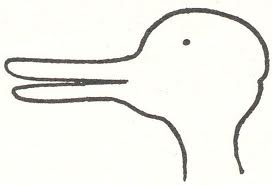
This phenomena shows why the old model of passive
perception is inadequate for understanding how perception works. For Locke, he thought it was enough to talk
about the object, the perceiving organ and the
perception. On this view the object
“impresses” itself on the mind and the
mind is simply the inert passive recipient of the information.
 We can complicate this simple model a bit by
talking about the object, the organ, the retinal image, and the
perception. But again, on this model,
the perception is understood as the inevitable product of the retinal
image. Mind plays no active role.
We can complicate this simple model a bit by
talking about the object, the organ, the retinal image, and the
perception. But again, on this model,
the perception is understood as the inevitable product of the retinal
image. Mind plays no active role.


But
in the case of ambiguous images, the poverty of this view is revealed. In the case of the “Duck/Rabbit” image, I can
see a duck or I can see a rabbit, that is I can have
the duck-perception or the rabbit-perception and which perception I have cannot
be explained in terms of the object, the organ or the retinal image. When I have the duck-perception, the object,
the perceiving organ and the retinal image are the same as when I have the rabbit-perception. There must be some other factor that
explains the difference in perception, and that factor is the activity
of mind. The old Lockeian model of mind simply
cannot account for the phenomena.

Opens
the door to Radical Relativism:
Kant
believed that our (human) empirical knowledge was universal (NOT RELATIVE)
because the pure forms of experience and the categories of thought were
universal for all humans. Therefore, he was certain that what is true for one
human is true for all humans.[23]
BUT....one
might object to Kant’s view.
For
instance, what if we do NOT all put the world together in basically the same
way (e.g. woman according to a female template, men
according to a male template)? If “Men
are from mars and women are from Venus” then we are not experiencing the same
worlds because we are building our worlds, shaping our experience, with the
same input, but according to different templates. We are, in a very real sense, living in
different worlds, and truth must be relativized to groups of cognizers who possess the same template. Rather than univalent, truth becomes bivalent
or, perhaps, multivalent. Truth is
potentially as multifaceted as there are minds, and no basis would exist for
claiming that any particular worldview was privileged
among the plurality.[24]
This
realization gave rise to the Post-modernists’ notion
that there is no one point of view from which Truth can be determined. Imagine
two groups of people, one who could only see the duck and one that could only
see the rabbit. Which group is seeing
what is “really there” and which group is wrong? Well of course we see in this example that
there is no reason to think that either group is privileged here. Further, the only reason we could have to say
that one of them has truth and the other has falsehood and is not seeing the world
“correctly” would be to advance a political, economic
or social agenda.
We see with
Empiricism in general and Locke in particular a focus on propositional
knowledge. The substance of this
knowledge is confined to empirical claims and logical tautologies. Claims not falling within the categories fall
outside the domain of knowledge and, consequently, serious inquiry. However A .J. Ayer’s
and the Positivist’s account of knowledge seems too narrowly
circumscribed. They, in essence, created
a club so exclusive that it wouldn’t let them in.
We also noted that
the passive model of perception coming to us from Empiricism is flawed and
inadequate to account for human experience and knowledge. The mind is active in perception and our
experience of the world is a result of that the world is giving us and what our
minds do with this input. The act of
perceiving the world is inseparable from the act of interpreting the
world. Kant offers this account, in
part, to answer the skeptical worries of both Rationalism and Empiricism. But we notes that he
inadvertently opens the door to entirely new challenge to those seeking
absolute truth and universal knowledge.
Despite the
shortcomings of both Positivism and passive models of mind, both remain
extremely influential on contemporary popular understanding about the nature
and substance of knowledge and truth.