Intracellular Biomacromolecular Delivery
Efficient intracellular delivery of proteins remains one of the most significant unmet challenges in therapeutic development. Proteins possess unparalleled specificity and functional diversity, enabling mechanisms of action that are inaccessible to small molecules. However, their clinical translation is severely limited by poor cellular entry, endosomal sequestration, and loss of biological activity during delivery. Existing carrier systems often rely on strong electrostatic complexation or membrane disruption, which can compromise protein structure, induce cytotoxicity, and exhibit limited generality across protein classes and cell types. As a result, most protein therapeutics remain restricted to extracellular targets, leaving a vast intracellular therapeutic space largely untapped.
Our research addresses these limitations through the development of novel functional-group–driven delivery systems that enable efficient cellular entry while preserving protein function. We focus on the design and implementation of phenyl carbamoylated guanidine (PhCG) as a modular functional group that promotes intracellular access without relying on highly cationic or disruptive mechanisms.
PhCG is uniquely suited for intracellular protein delivery due to the following key characteristics:
- Charge neutrality at physiological pH, reducing nonspecific electrostatic interactions and cytotoxicity
- Coplanar molecular geometry, enabling directional hydrogen bonding and favorable membrane interactions
- Balanced hydrophobic–hydrogen bonding character, facilitating membrane association without permanent disruption
To elucidate how polymer architecture influences intracellular delivery efficiency, we systematically integrate PhCG into chemically distinct polymer backbones, including polynorbornene, conjugated polymers, and ε-polylysine. This comparative framework allows us to decouple the roles of functional-group chemistry and polymer scaffold in governing protein complexation, cellular entry pathways, and intracellular fate, ultimately establishing structure–function relationships that guide the rational design of next-generation intracellular protein delivery systems.
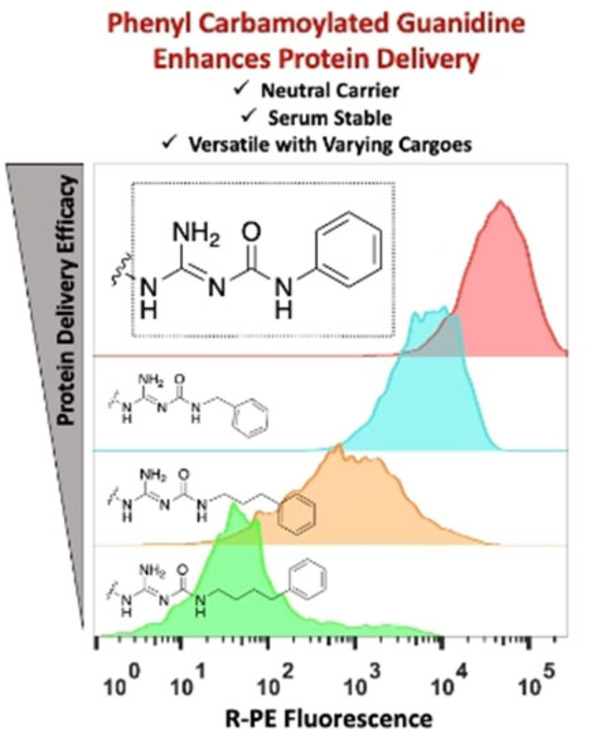
J. H. Moon et al., Angew. Chem. Int. Ed.
DOI: 10.1002/anie.202116722
© Wiley-VCH Verlag GmbH & Co. KGaA, 2022.
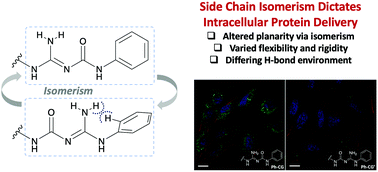
J. H. Moon et al., Chem. Commun.
DOI: 10.1039/D2CC02343A
© The Royal Society of Chemistry, 2022.