Synthesis of Vortex Rossby Wave Dynamics
Israel Gonzalez III1,Amaryllis Cotto2,
and Hugh E. Willoughby1
(1Dept. of Earth and Environment, FIU, Miami FL
2 NWS/WFO, San Juan PR)
HEW (PI) may be reached at Phone: 305-348-0243
Email: hugh.willoughby@fiu.edu.
Contents:
IntroductionIntermittently Forced VRWs
Vortex Motion on a β-plane
Vorticity Monopoles on a Sphere
Wavenumber-1 VRWs on a Moving Votex
"Waveguide Thinking" Applied to Synoptic-Scale Waves
Summary
References
Introduction
Vortex Rossby Waves (VRWs) plausibly play significant roles in Tropical-Cyclone (TC) intensity change and motion. The idea was first proposed by MacDonald (1968) and articulated in its modern from by Guinn and Schubert (1993) and Montgomery and Kallenbach (1997). VRWs are approximately balanced (e.g., Shapiro and Montgomery 1993) vorticity waves that propagate upon the axially symmetric radial gradient of mean-vortex relative vorticity. In monopole cyclonic vortices, they propagate upstream with an intrinsic phase velocity slower than the mean swirling flow. Consequently, the mean flow advects them cyclonically downstream around the vortex. Since VRWs appear as rotational motions organized into trailing spirals, they should sustain eddy fluxes of angular momentum toward the vortex center (MacDonald 1968). It seems reasonable to identify at least some spirals of organized convection (e.g., Senn and Hiser 1959, Wexler 1963) in TCs as VRWs.
Many of theoretical studies of VRWs are based upon WKB analyses (e.g. Montgomery and Kallenbach 1997), or more commonly upon piecewise analytical solutions on a vortex composed of discrete rings of constant vorticity (e.g., Guinn and Schubert 1993, Kossin et al. 2000, Terwey and Montgomery 2002). The tri-diagonal solution method of Lindzen and Kuo (1969, hereafter LK) is an alternative technique that offers conceptual simplicity at the cost of obtaining purely numerical solutions. With it, one can solve the linear governing equations for individual Fourier components with specified boundary conditions at both ends of the radial domain (e.g., Willoughby 1977). In this technique, the Doppler shifted frequency, Ω, varies across the domain as the mean-vortex wind changes with radius. Because of their slow propagation speeds, one would expect VRWs to be confined to relatively narrow waveguides bounded by Ω = 0 and Ω = Ω1D, the frequency of a one-dimensional VRW. In the barotropic nondivergent model, Ω1D is the Doppler-shifted frequency of a one-dimensional VRW with the specified tangential wavenumber—effectively the VRW cutoff frequency here.
Willoughby (1977, 1978ab) initially applied the LK algorithm in an attempt to model VRWs as part of his dissertation research. The problem was formulated as a single partial differential equation for the geopotential derived from the divergent primitive equations. The model should have supported both VRWs and gravity waves. In retrospect, it is clear that the search for relatively narrow, trailing-spiral VRW geopotential fields came to naught because the waves were confined radially by the Doppler shift and because low-frequency geopotential (unlike vorticity) does not organize itself in to narrow trailing spirals. The research did, however, yield realistic looking internal gravity-wave solutions (Willoughby 1978ab). Here we reexamine the forced VRW problem in light of more nuanced understanding.
Vortex Motion on a β-plane (e.g., Willoughby 1992, hereafter W92) is another topic that can be reconsidered in terms of VRWs. W92's linear, time-domain, shallow-water, divergent model was set in translating, cylindrical coordinates on a β-plane. The vortex accelerated poleward and westward without limit. This model simulated the Wavenumber-1 (WN-1) asymmetry on a fixed-structure, axially symmetric, moving mean vortex. The asymmetry was forced through advection of planetary vorticity by the mean vortex swirling wind. In the northern hemisphere, it consisted of two counter rotating streamfunction β-gyres, one northeast of the center and the other southwest of it, such that the flow between them advected the vortex toward the northwest.
A plausible explanation for the limitless acceleration was that the β-gyres represented a free VRW mode that was resonantly excited by the mean vortex's advection of the planetary vorticity gradient (Willoughby 1992, 1995). A somewhat similar calculation (Montgomery et al.1999) reported different results. This calculation used the Asymmetric Balance (AB) approximation (Shapiro and Montgomery et al. 1993) set in fixed coordinates. The AB model's motion was significantly different from that in W92. It asymptoted after > 240 h , but at a speed (6 m s -1) that was both faster than full-physics models or observations and not much slower than W92's 8 m s-1 after ten simulated days. In the analogous nonlinear model (Willoughby 1994, hereafter W94), where waves with azimuthal WN ≥ 1 could interact with each other, the poleward motion was limited to reasonable values (e.g., Holland 1983).
Key results from this work are clarification of the interactions between VRWs and the mean vortex, confirmation or refutation of the existence of a linear β-gyre mode, and better understanding of the nonlinear motions of intense vortices. Here, we focus on barotropic, nondivergent models because they represent the simplest formulation that captures VRW's essential rotational dynamics. Much of the existing literature is both conceptually difficult and arcane. Our hope here is to explain these complicated phenomena in a more accessible and consistent way that pays careful attention to terminology and definitions. The computations are done entirely in MATLAB, and well-documented MATLAB scripts (m-files) are avilable from the authors.
Intermittently Forced VRWs
 Classical Fourier series techniques form the basis for simulations of intermittently forced VRWs (Cotto 2012, 2015). In the time domain, the forcing
is initially zero. Its amplitude increases to a maximum and then declines back to zero over a period of 1.5 hours. The forcing rotates around the center twice. It is then quiescent for 4.5 hours before another cycle begins (Fig. 1. Click on thumbnail to view the figure and caption in a new window.)
Classical Fourier series techniques form the basis for simulations of intermittently forced VRWs (Cotto 2012, 2015). In the time domain, the forcing
is initially zero. Its amplitude increases to a maximum and then declines back to zero over a period of 1.5 hours. The forcing rotates around the center twice. It is then quiescent for 4.5 hours before another cycle begins (Fig. 1. Click on thumbnail to view the figure and caption in a new window.)
 In the frequency domain, the forcing can be represented as a Fourier series (Fig. 2). All Fourier components of the forcing have the same wavenumber, n, but each has its own rotation frequency, ω, with respect to the ground, and amplitude. Each component excites a steady wavetrain of VRWs whose radial structure can be computed by solving the barotropic, nondivergent vorticity equation with LK algorithm. Since Ω = ω - nV0/r varies radially, each component has its own annular waveguide between the radius where Ω is Doppler shifted to the VRW cutoff frequency, and where Ω is Doppler shifted to zero (Fig. 3).
 Consequently the waves can propagate radially only in 10-20 km wide annuli bounded by turning (cutoff) radii where Ω = Ω1D = (∂ζ0/∂r)(n/r)-1, and by the VRW critical radii where Ω = 0. The waves reflect from the cutoff radii; although they have evanescent tails that extend inward. Their vorticities become filamented and they are absorbed at critical radii
 Although the VRW vorticity fields are dominated by trailing spirals that become strongly filamented in the neighborhood of the critical radius, the corresponding geopotential and streamfunction fields generally take the form of elliptical gyres that do not resemble hurricane spiral bands (Fig.4). This difference arises because of the smoothing inherent in Poisson solutions to obtain streamfunction from vorticity.
 The time evolution of the episodically excited wavetrain derives from a superposition of the steady Fourier-component wavetrains (Fig.5). As the forcing ramps up, elliptical gyres dominate the streamfunction field while triangular segments characterize the evanescent vorticity inside the cutoff radius. As the calculation progresses, the streamfunction gyres distort into trialing spirals and the vorticity becomes increasingly filamented. Ultimately, the streamfunction spirals fade away as nearly all of the vorticity stagnates in the neighborhood of the critical radius where the radial group velocity is small. Some remnants of filamented vorticity persist to the start of the next forcing cycle.
Key results of these calculations are the narrow radial width of the VRW waveguides for WN ≥ 2, transient trailing spirals recognizable as TC spiral bands in the streamfunction or geopotential (not shown) fields, and rapid filamentation and absorption of vorticity at the VRW critical radius. In the present barotropic, nondivergent model the streamfunction and vorticity fields are generally smoother than they would be in divergent models because the Rossby radius of deformation is effectively infinite here. A follow-on investigation (see below) extends this calculation to WN-1, which has a wider waveguide and affects the vortex motion.
Vortex Motion on a β plane
The meridional gradient of planetary vorticity, β, is observed (Holland 1982) to cause TCs to propagate poleward and
 westward at ~2 ms-1 (Fig. 6). In W92's shallow-water, linear model, the vortex accelerated without limit, ostensibly because β forced a free linear mode. The present linear, barotropic, nondivergent model embodies a time-domain semispectral representation of the WN-1 vortex asymmetry.
 Closure for the motion involves identifying the "α-gyre" (pseudo-mode) asymmetry due to mislocation of the extrapolated center and repositioning the vortex to minimize it. The model produces the familiar WN-1 "β- gyres," with a cyclone west-southwest of the center and a cyclone east-northeast of it (Fig. 7). Thus the flow bewteen the gyres advects the TC poleward and westward. In the analogous nonlinear model (w94), wave-wave interaction limited the propagation speed. Subsequent work (Montgomery et al. 1999) based upon the AB approximation was unable to replicate the linear result.
The present barotropic nondivergent, vortex-following model is the simplest framework within which to study rotational dynamics of vortex motion initialized from rest in a quiescent environment on a β-plane. Here vorticity is the prognostic variable, and the streamfunction is obtained by inverting the Poisson-like relation after each time step with the LK tridiagonal algorithm. These linear results attempt to replicate the vortex-following, linear shallow-water, primitive equation model of W92 in a completely reformulated MATLAB implementation. This model simulates β-gyres with southeast-to-northwest flow between them and a steadily accelerating northwestward motion. This asymmetry's waves' properties are consistent with VRWs that propagate downstream on the reversed mean-flow vorticity gradient at the periphery of the asymptotically bounded mean vortex.
In bounded profiles, the Circulation (i.e., Stokes') Theorem requires that the circulation around an area be
 equal to the integral of the vorticity over the area enclosed on the surface of any closed manifold (such as the spherical Earth), so that the wind either becomes zero at some finite radius of asymptotes to zero at large radius. Both profiles contain cyclonic vorticity near the centers surrounded by equal amounts of anticyclonic vorticity. This condition implies the existence of an outer waveguide (Fig. 8) in which a reversed vorticity gradient (i.e., becoming less anticyclonic outward) can support downstream-propagating VRWs (Gonzalez et al. 2015).
For small diffusion (K < 1 m2 s-1), the vortex accelerates throughout the simulation. For larger K values, it asymptotes at an unphysically fast speed, consistent with previously published AB results. The radial variation Doppler-shifted frequencies illustrate that the β-gyres behave like a leaky normal mode with a vortex Rossby wave critical radius at the inner edge of the outer waveguide. The Ks used here are more than an order of magnitude smaller than those used previously. Nonetheless, somewhat finer resolution and application of the diffusion to vorticity, rather than to velocity components and mass variables, increases the effect of dissipation on the strongly filamented vorticity near the VRW critical radius.
 The analogous nonlinear results (Fig. 6, revisited) also replicate W94 inasmuch as wave-wave interactions limit the vortex
translation speed to reasonable values. In addition, appearence of nonlinearly forced "anti β-gyres" reveals a clear and readily understood mechanism for reduced speed (Fig. 9). Nonlinear interaction of WN-1 with
The analogous nonlinear results (Fig. 6, revisited) also replicate W94 inasmuch as wave-wave interactions limit the vortex
translation speed to reasonable values. In addition, appearence of nonlinearly forced "anti β-gyres" reveals a clear and readily understood mechanism for reduced speed (Fig. 9). Nonlinear interaction of WN-1 with
 itself forces WN-2. WN-2 then interacts with WN-1 to force a nonlinearly excited WN-1 asymmetry that has more-or-less the same structure as the linear β-gyres, but opposite polarity. Thus, the flow they induce across the vortex partially cancels the linear southeast-to-northwest flow between the β gyres and so limits the vortex speed.

Two additional replications of the earlier normal-mode results are frequency-domain simulations and reinitialization. In the frequency-domain model, inner boundary conditions on an annular domain suppress the α-gyre asymmetry and the vorticity equation is forced at a specified low frequency. The resulting WN-1 asymmetry at very low cyclonic frequencies has structure and orientation consistent with the β-gyres. In reinitialization, the β-effect forcing is turned off at a specified simulated time and the vorticity field is scaled or reoriented (Fig. 10). The vortex turns slowly in a cyclonic sense, consistent with the low cyclonic frequencies of free VRWs in the outer waveguide. As vorticity leaks inward to the VRW critical radius, the β-gyres and motion decay fairly quickly at first and then more slowly before leveling off through the end of the simulation.
Vorticity Monopoles on a Sphere

Cyclonic vorticity monopoles contain positive vorticity only in their inner cores and are irrotational elsewhere (Fig.11). This structure means that Rankine (monopole) vortices are inconsistent with Stokes' Theorem on a spherical Earth (or any closed manifold), because it implies anticyclonic circulation about the antipode of the vortex center. To better understand the argument for use of bounded vortices, imagine sphere a with no vorticity except for a lone cyclonic patch. From the perspective of an observer in the patch the circulation is cyclonic and equal to the vorticity enclosed; from the perspective of an observer at the antipode, the circulation would appear to be anticyclonic but with no enclosed vorticity. To avoid this contradiction, the component of the curl normal to the surface of any closed manifold must integrate to zero. Thus, vorticity monopoles are logically inconsistent with basic kinematics on a sphere.
Wavenumber-1 VRWs on a Moving Vortex
Convectively forced wavenumber-1 VRWs are intriguing objects for study because, unlike higher-wavenumber waves, they force vortex motion and propagate in the widest possible Rossby waveguide. Here, the same two-dimensional barotropic, nondivergent, vortex-following model is used to simulate them in time domain on an f-plane. As in Cotto et al. (2015), the forcing represents eyewall convection as a mass source-sink pair that rotates with specified cyclonic frequency, ω. However, the problem is framed in time domain instead of frequency/Fourier domain. The mean, axially symmetric vortex has a Wood-White profile with 50 m s-1 maximum wind at 25-km RMW. By default, ω is set to a quarter of the angular velocity at the RMW, V0/r.
As before, the VRWs' Doppler-shifted frequencies lie between Ω = 0 and Ω1D, so that they propagate between a turning point inside the Radius of Maximum Wind (RMW), where they are reflected, and an outer critical radius where they are absorbed. Ω is thus confined to a wider passband. However, the outward decrease of Ω1D may lead to trapping between two turning points. Since the trapped waves are subject to limited vorticity filamentation they can grow resonantly to substantial amplitude, which fact may have consequences for vortex motion and intensification.
The streamfunction field (Fig. 12) exhibits a rotating dipole with maximum amplitudes at the forcing radius. Excited VRWs propagate propagate radially both inward and outward from the forcing locus. Initially inward propagating VRWs are reflected from the turning point a few kilometers inward from the RMW and then propagate outward to the critical radius where they are ultimately absorbed. Thus, the initially inward propagating wavetrain sustains zero net geopotential flux between the forcing locus and the turning point and an outward geopotential flux from the forcing locus to the critical radius. Ultimately, both the initially outward and initially inward propagating wavetrains reach the critical radius where they are absorbed. This effect causes vorticity to accumulate at the waveguide's outer boundary and become tightly wound, filamented trailing spirals.
The dipole at the
forcing locus near the RMW that rotates in phase with the forcing. An outer dipole
asymmetry is forced though advection of mean-vortex vorticity by the vortex translation.
Presence of the outer dipole is an emergent behavior of the outer waveguide discussed
in Gonzalez et al. (2015). The vorticity field shows trailing spirals shaped by strong
filamentation of the outward propagating VRWs. At the critical radius, the waves become radially-short and tightly wound.
This result illustrates how VRWs contribute to spiral rainband formation in TCs.
The vortex center rotates with the forcing around a 16-km circle with a rotation
period of 3.5 hr. This result is reminiscent of observed TC trochoidal motion.
Initially the vortex translation experiences start-up transient of between 1
and 5ms-1 before leveling off at 3ms-1 and then
subsiding to < 1 ms-1 after the forcing is turned off.
 Residual asymmetries (Fig. 13) persist for a long time (226 h), albeit at small amplitude,
after the forcing is turned off because filamentation is slow in the outer waveguide.
Residual asymmetries (Fig. 13) persist for a long time (226 h), albeit at small amplitude,
after the forcing is turned off because filamentation is slow in the outer waveguide.
"Waveguide Thinking" Applied to Synoptic-Scale Waves

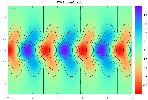
Re-purposing of the approach used to understand VRWs to the synoptic-scale middle-latititude atmosphere yields a conceptually simple understanding of conventional Rossby waves (Fig. 14). In this numercical Green's function simulation, waves in a meridionally sheared zonal flow are excited in the neighborhood of a selected latitude with specified frequency and zonal wavenumber. They propagate in a waveguide confined on the equatorward side by a critical latitude where their frequency is Doppler shifted to zero and on the poleward side by a turning point where their frequency is Doppler shifted to the Rossby-wave cutoff frequency. Between the forcing latitude and the critical latitude the waves transport wave energy equatorward and westerly momentum poleward. Waves that propagate poleward from the forcing latitude are reflected from the turning point so that there is zero net transport between the forcing and turning latitudes. Consequently the forcing latitude is a locus of strong westerly momentum convergence and wave-energy divergence. The foregoing is consistent with the conventional understanding of synoptic-scale Rossby-wave dynamics, but it offers a particularly easy-to-comprehend explanations of Rossby wave dynamics in sheared mean flows, the waves' role in the large-scale atmosphere, and the comma shape of observed frontal cyclones.
Rossby waves in uniform shear are hydrodynamically neutral. Can waveguide thinking provide insight into unstable waves? Barotropic instability of shear or jet flows (e.g. Kuo 1949, Lindzen and Tung 1978, Tung 1981) is the simplest meteorologically relevant example. Mean-flow anticylonic relative vorticity has maximum on the equatorward side of a bounded westerly jet (Fig. 15) with no backgound rotation, and cyclonic mean relative vorticity has a maximum on its poleward side. Thus, the flanks of the jet contain waveguides in which Rossby-like waves propagate downstream and the axis contians a waveguide where they propagate uptream. Waves in the axial waveguide are trapped between turning points that define the waveguide boundaries, but they have evanescent tails that extend into the flanking waveguides where they excite downstream propagating waves. The downstream waves also have turning points at their outer margins, but they also have critical points adjacent to the boundary of the downstream waveguide. A key aspect of the "quantum condition" that defines the growing normal mode is that the streamwise wavelength and phase speed of the wavetrain have to maintian its continuity and to produce an arrangement of singular points that supports overreflection as described by Linzen and Tung (1978). The Generation of > 106 numerical Green's function solutions reveals a countable set of unstable solutions that produce large perturbation energy response to small resonant forcing.
Summary
Fourier synthesis of intermittently forced barotropic, nondivergent vortex Rossby waves with azimuthal wavenumbers ≥ 2 show that they can propagate only in relatively narrow annular waveguides. Their streamfunction fields are dominated by elliptical gyres that exhibit transient trailing spirals structure only occasionally. Their vorticity fields, by contrast, are deformed into trailing spirals that become tightly wound and filamented in the neighborhood of a critical radius, where their Doppler-shifted frequency approaches zero.
A moving, maintained, barotropic vortex on a β plane develops the β gyres, a pair of large-scale streamfunction gyres that advects the vortex westward and poleward. In a linear model that represents only the azimthal wavenumber one asymmetry, the gyres grow linearly and motion accelerates to unphysically fast speeds. In the corresponding nonlinear model wave-wave interactions force a pair of "anti β gyres," morphologically like the original ones but of opposite polarity, that controls the acceleration and limits the vortex translation to observationally reasonable speeds. An earler, linear primitive-equation model predicted acceleration without limit, because second-order diffusion applied to velocities and fluid depth underestimated dissipation at the critical radius. In the present linear model, similar diffusion, even with much smaller K, applied to the vorticity simulates limited, but still too-fast β drift.
Application of "Waveguide Thinking" developed in the tropical-cyclone context promises new insights into the structure and stability of synoptic-scale Rossby waves in shearing zonal flows and instabilities of jet and shear flows. It explains the coma shape of forced, neutral Rossby-wave streamfunction gyes in a uniformly sheared zonal flow, their westerly momentum convergence at the locus of forcing, and equatoward energy transport toward the critical latitude. It also promises a more nuanced understanding of classical barotropic---and potentially baroclinic--- instability. (Research supported by grants NSF-ATM-0454501, NSF-AGS-1211172, and NSF-AGS-1724198. Opinions expressed here do not necessarily reflect those of the National Science Foundation.)
References
Cotto, A., I. Gonzalez, III, and H. E. Willoughby, 2015: Synthesis of vortex Rossby waves. Part I: episodically forced waves in the inner waveguide. J. Atmos. Sci., 72, 3940-3956. doi/abs/10.1175//JAS-D-15-0004.1 .
Cotto, Amaryllis, 2012: Intermittently Forced Vortex Rossby Waves. FIU Electronic Theses and Dissertations. Paper 553. http://digitalcommons.fiu.edu/etd/553
Gonzalez, I., III, and H. E. Willoughby, 2016: Constraints on parametric hurricane wind profiles. Preprints, 32nd Conferencce on Hurricanes and Tropical Meteorology, American Meteorological Society, Paper 18A.10 in the conferecne CD.
Gonzalez, I., III, Cotto, A., and H. E. Willoughby, 2015: Synthesis of vortex Rossby waves. Part II: Vortex motion and and waves in the outer waveguide. J. Atmos. Sci., 72, 3958-3974. doi/abs/10.1175/JAS-D-15-0005.1
Gonzalez, I., III, 2014: Linear and nonlinear motion of a barotropic vortex. FIU Electronic Theses and Dissertations. Paper 1196. http://digitalcommons.fiu.edu/etd/1196 .
Guinn, T. A., and W. H. Schubert, 1993: Hurricane spiral bands, J. Atmos. Sci., 50, 3380-3403.
Holland, G.J., 1984: Tropical cyclone motion: A comparison of theory and observation. J. Atmos. Sci., 41, 68-75.
Kossin, J. P., W. H. Schubert, and M. T. Montgomery, 2000: Unstable interactions between a hurricane's primary eyewall and a secondary ring of enhanced vorticity. J. Atmos. Sci., 57, 3893-3917.
Kuo, H. L., 1949: Dynamic instability of two-dimensional nondivergent flow in a barotropic atmosphere. J. Meteorol., 6, 105-122.
Lindzen, R. S. and K. K. Tung, 1978: Wave overreflection and shear instability. J. Atmos. Sci., 35, 1626-1632.
Lindzen, R. S. and H. L. Kuo, 1969: A reliable method for the numerical integration of a large class of ordinary and partial differential equations. Mon. Wea. Rev., 97, 732-734.
MacDonald, N. J., 1968: The evidence of the existence of Rossby-like waves in the hurricane vortex. Tellus, 20, 138-150.
Montgomery, M. T., and R. J. Kallenbach, 1997: A theory of vortex Rossby waves and its application to spiral bands and intensity changes in hurricanes. Quart. J. Roy. Meteor. Soc., 123, 435-465.
Montgomery, M. T., J. D. Moller, and C. T. Nicklas, 1999: Linear and nonlinear vortex motion in an asymmetric balance shallow water model. J. Atmos. Sci., 56, 749-768.
Senn, H. V., and H. W. Hiser, 1959: On the origin of hurricane spiral rain bands. J. Meteor., 16, 419-426.
Shapiro, L. J., and M. T. Montgomery, 1993: A three-dimensional balance theory for rapidly rotating vortices, J. Atmos. Sci., 50, 3322-3335.
Terwey, W. D., and M. T. Montgomery, 2002: Wavenumber-2 and wavenumber-n vortex Rossby wave instabilities in a generalized three-region model. J. Atmos. Sci., 59, 2421-2427.
Tung, K. K., 1981: Barotropic instability of zonal flows. J. Atmos. Sci., 38, 308-321.
Wexler, H., 1947: Structure of hurricanes as determined by radar, Ann. N. Y. Acad. Sci., 48, 821-844.
Willoughby, H. E., 1994: Nonlinear motion of a shallow-water, barotropic vortex. J. Atmos. Sci., 51, 3722-3744.
Willoughby, H. E., 1992: Linear motion of a shallow-water barotropic vortex as an initial-value problem. J. Atmos. Sci., 49, 2015-2031.
Willoughby, H. E., 1978: The vertical structure of hurricane rainbands and their interaction with the mean vortex. J. Atmos. Sci., 35, 849-858.
Willoughby, H. E., 1978: A possible mechanism for the formation of hurricane rainbands. J. Atmos. Sci., 35, 838-848.
Willoughby, H. E., 1977: Inertia-buoyancy waves in hurricanes. J. Atmos. Sci., 34, 1028-1039.
Wood, V. T., and L. W. White, 2010: A new parametric model of vortex tangential wind profiles: Development, testing, and verification. J. Atmos. Sci., 68, 990-1006.
(Latest Revision by HEW. 22 JUNE 2018)