Reviews
Early Music America
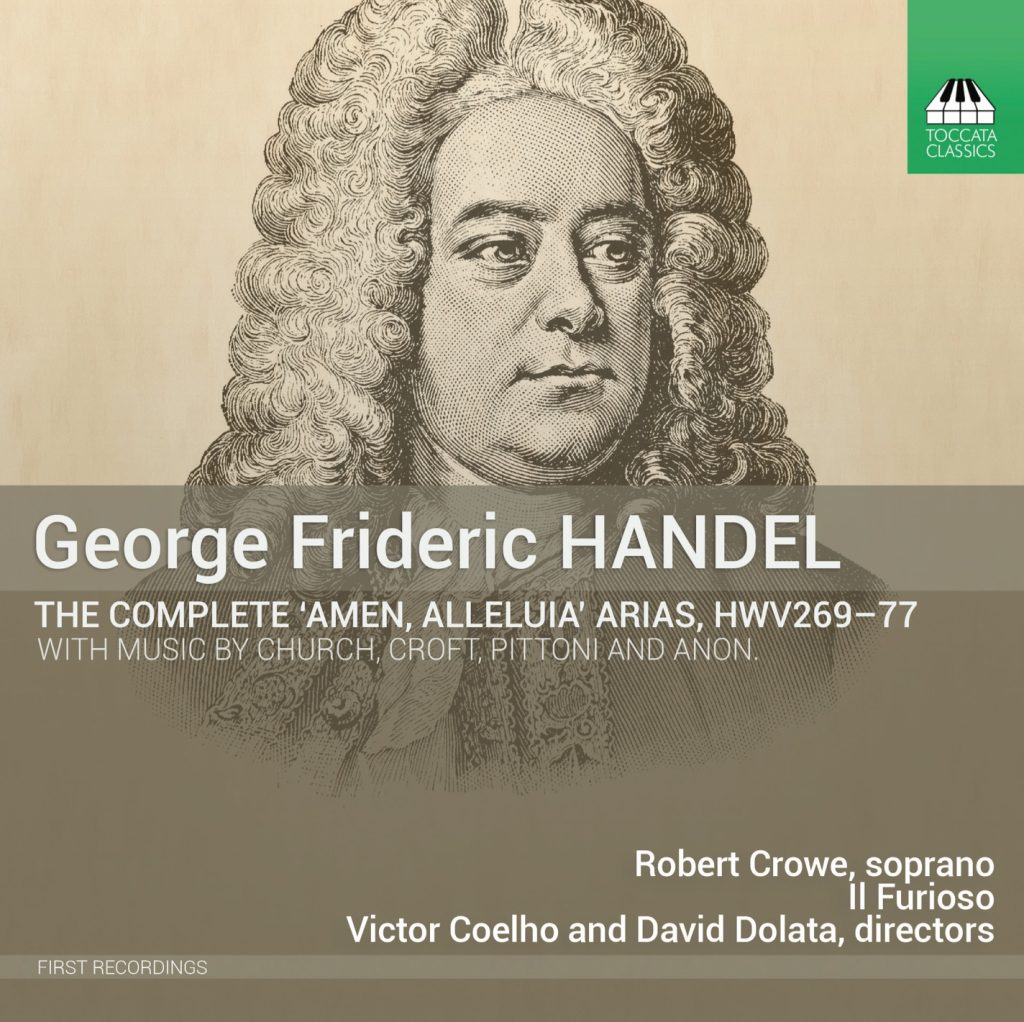
Handel: The Complete Amen, Alleluia Arias Robert Crowe, soprano, and Il Furioso Toccata Classics TOCC0337
By Andrew J. Sammut
CD REVIEW — Nearly half of this disc is made up of Handel’s settings of the words “Amen” and/or “Hallelujah,” likely intended for performance in private homes and deliberately light on lyrical content. Yet Handel makes these spiritual declarations by turns reflective (HWV 271), resigned (HWV 274), joyous but refined (HWV 276), virtuosic (HWV 277), and, of course, triumphant (HWV 275). The album also includes three vocal works from the Harmonia Sacra, a collection of sacred solo songs published in various editions during the late 17th century and also aimed at home use: William Croft’s bright, heavily ornamented hymn to music, an anonymous composer’s graphic vision of Christ’s crucifixion, and John Church’s emotionally ranging “A Divine Hymn,” which soprano Robert Crowe calls “a truly underappreciated masterpiece.”
This music was intended for “amateur” musicians, meaning “non-professional” rather than “unskilled, dilettante” and certainly not “student,” according to Crowe. These works are technically involved and expressive, and the musicians approach them with obvious knowledge and affection. Crowe explained over email that “the limited word choice [in the Amen and Hallelujah arias] and those two words both containing relatively broad, powerful meanings meant that the affect had to be gleaned not from text but from the music written to undergird it.” Crowe’s musical instincts are spot-on throughout as he explores each work’s unique character. He tosses off some impressive sudden register shifts, including an unexpected dip into chest voice following chiming, upperregister melismas at the end of Croft’s “A Hymn On Divine Music.” Even during the most ornate line of the three Harmonia Sacra pieces, Crowe demonstrates fine diction and consistency of tone. Robert Crowe
The American-Canadian ensemble Il Furioso partners Crowe with chamber organ and one or two theorbos on each track. The liner notes explain the historical precedent for the double theorbos, but the warm, undulating wash underneath and around Crowe justifies itself on purely sonic terms. The first, unornamented performance of HWV 270 (as opposed to the ornamented version closing the disc) is a great example of the simple but powerful effect of one theorbo doubling the organ’s bass line while another plucks the harmonies. HWV 269 is a superb example of the whole ensemble — singer and instrumentalists — breathing together and feeling the pulse as one. Theorbo sonatas by the obscure Ferraranese composer and theorbo virtuoso Giovanni Pittoni spotlight Il Furioso co-directors Victor Coehlo and David Dolata. Charming excerpts composed by Handel for mechanical musical clock showcase organist Juvenal Correa-Salas.
This reviewer had difficulty with the recording’s audio engineering, such as rumbling on Crowe’s highest notes and some muddiness in the instruments’ lower ranges (even after trying the disc on three sound systems). Those strictly technological issues aside, the origins of these works in private musicking, the spare accompaniment, and the musicians’ sensitive interplay make this a thoroughly intimate affair.
Andrew J. Sammut has written about European classical music as well as American classical music for All About Jazz, The Boston Musical Intelligencer, Early Music America, the IAJRC Journal and his own blog.
Avvenire.it
Robert Crowe’s Vocal Boldness and Il Furioso Thrill with Händel’s Arias
Andrea Milanesi
Friday, July 21, 2017
Pure and simple exercises of study and skill or compositions with a precise and autonomous artistic dignity? The question arises spontaneously in face of the recording of the complete “Amen – Alleluia” Arias HWV 269-77 by Georg Friedrich Händel (1685-1759) performed by soprano Robert Crowe and by the ensemble Il Furioso directed by theorbo players Victor Coelho and David Dolata.
Over the course of two decades, from the late eighties of the eighteenth century, the Saxon Master conceived a series of nine songs characterized by a fair level of virtuosity, using only the words “Alleluia” and “Amen.” Not only a bold challenge, but perfectly accomplished thanks to the technical mastery, to the inventive freshness, and to the elegant idiom of Handel’s genius. It’s a matter of songs that someone wanted to understand as “beautiful song introductions,” but that also reveal a facility only apparent, especially in the later ones, written when the composer was the leading protagonist of the English musical stage thanks to the production of Anthems and above all of great oratorios like Saul, Israel in Egypt, or Messiah.
Far beyond a series of didactic lessons in solfege, these are real arias of exquisite workmanship; do not be misled by the monotony of the text because the variety of the expressive range displayed here deeply explores the different nuances that can be traced back to two words so fundamental to the Christian religion; from pleasure to jubilation and to joy, passing through anguish and melancholy, resignation and pure contemplation.
Solid and of great taste, the instrumental accompaniment completely supports the dramatic temperament and Crowe’s not always impeccable vocal acrobatics. The collection also includes three pieces for organ obtained from original cylinders, probably engraved by Händel himself; direct and first-hand testimony that goes far beyond mere philological issues.